A dishwasher spends its life cleaning plates, glasses, pans, and utensils, so it is easy to assume the machine cleans itself.
It does not.
Food particles, grease, detergent residue, mineral deposits, and moisture can build up inside the dishwasher. The result may be cloudy glasses, unpleasant smells, dirty filters, or dishes that come out with a film even though you are using the same detergent you always have.
Learning how to clean a dishwasher is not complicated, but it needs to be more thorough than running an empty cycle once in a while. The filter, spray arms, door seal, detergent area, drain area, and interior all need attention.
This guide explains how to deep clean a dishwasher, how to clean the filter, how to deal with smells, when vinegar or baking soda can help, and what to do when dishes remain cloudy after cleaning.
Why You Need to Clean Your Dishwasher
A dishwasher removes food and grease from dishes, but some of that material does not disappear completely.
Small particles can collect in the filter.
Grease can stick to the tub and door.
Mineral deposits can build up around spray holes and heating components.
Detergent residue can collect around the dispenser.
Moisture can remain inside after a cycle, especially when the door stays closed.
Over time, this can affect how the dishwasher smells and how well it performs.
How Often Should You Clean a Dishwasher?
The right frequency depends on how often you use the appliance.
For many homes, a quick filter inspection every week or two and a more complete cleaning about once a month is a practical routine.
Clean sooner if:
- The dishwasher smells bad
- Glasses look cloudy
- Food particles remain on dishes
- The filter looks dirty
- The spray arms have blocked holes
- You notice grease inside the tub
- The door seal has visible buildup
A dishwasher used several times a day may need more frequent attention than one used a few times a week.
What You Need
You do not need many supplies:
- Dish soap
- Warm water
- Soft sponge
- Microfiber cloth
- Soft toothbrush or small brush
- Toothpick or soft detail tool for spray holes
- Baking soda, if appropriate
- White vinegar, if approved by the manufacturer
Always check the dishwasher manufacturer’s instructions before using vinegar, baking soda, or another cleaning product.
How to Clean a Dishwasher Step by Step
Step 1: Empty the Dishwasher
Remove all dishes, racks, and loose items that can be safely removed.
Check the bottom for food scraps, broken glass, labels, or other debris.
Wear gloves if you are handling sharp debris.
Step 2: Clean the Filter
The filter is one of the most important parts of the dishwasher.
Many modern dishwashers have a removable filter near the bottom of the tub.
Remove it according to the manufacturer’s instructions.
Rinse the filter under warm water.
Use a soft brush to remove stuck-on particles.
Do not use a wire brush or aggressive scrubber that could damage the filter.
Reinstall it securely before running the dishwasher.
A dirty filter can restrict water flow and allow food residue to remain in the machine.
Step 3: Inspect the Spray Arms
Check the spray arms for food particles and mineral deposits.
If the spray holes are blocked, water cannot reach the dishes properly.
Use a soft brush or appropriate tool to clear debris.
Do not enlarge the holes or force sharp objects deep into the spray arm.
If the spray arm is removable, clean it according to the manufacturer’s instructions.
Step 4: Clean the Door and Gasket
The door gasket can collect food particles, grease, and detergent residue.
Use a damp microfiber cloth with mild dish soap.
Wipe along the entire gasket.
Pay attention to corners and folds.
Clean around the door edge and detergent dispenser as well.
Do not use abrasive cleaners on the rubber seal.
Step 5: Clean the Interior
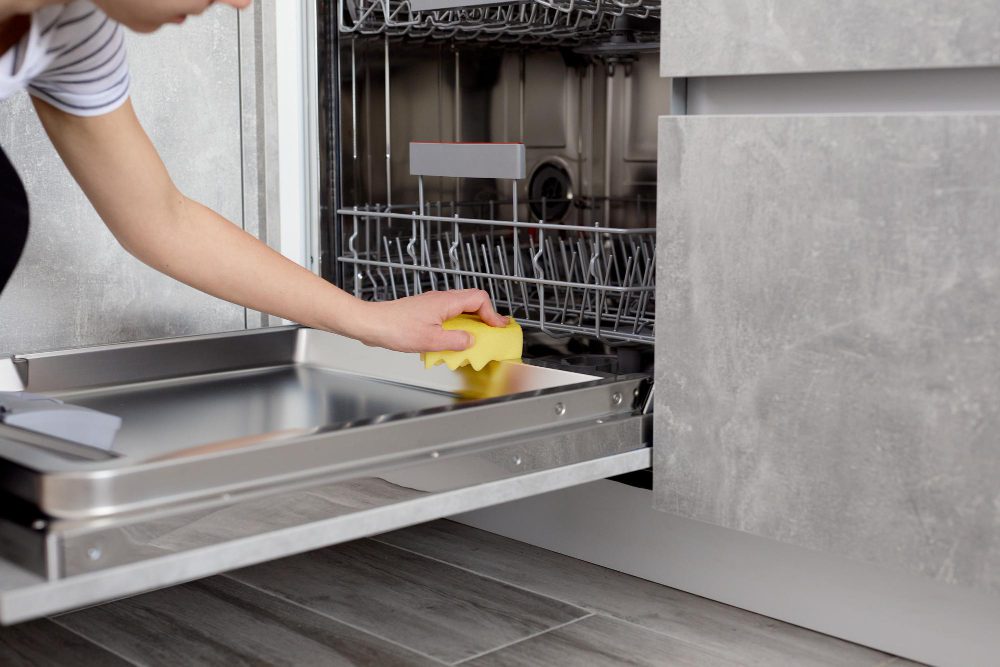
Use a damp cloth and mild dish soap to wipe visible buildup from the interior walls and door.
Focus on:
- Bottom corners
- Door edges
- Around the filter
- Under the door
- Areas around the detergent dispenser
Avoid flooding the interior with cleaner.
Step 6: Check the Drain Area
Look around the bottom of the dishwasher for food particles and debris.
Do not disassemble plumbing components unless the manufacturer’s instructions explain how to do so safely.
If the dishwasher is draining slowly or leaving standing water, a plumbing or appliance issue may be involved.
Step 7: Clean the Racks
Remove the racks if practical.
Wipe them with warm soapy water.
Inspect the wheels and rails for debris.
If the rack coating is damaged and metal is exposed, check the manufacturer’s guidance because rust can develop over time.
How to Clean a Dishwasher With Vinegar
Vinegar can help with some mineral residue and odors, but it is not a universal dishwasher cleaner.
If the manufacturer allows vinegar, place the recommended amount in a dishwasher-safe container on the upper rack and run an appropriate hot cycle according to the appliance’s instructions.
Do not mix vinegar with bleach or products containing bleach.
Do not pour large quantities of acid directly into a machine unless the manufacturer recommends that method.
Vinegar should be treated as one possible maintenance option, not a replacement for cleaning the filter and removing physical debris.
How to Clean a Dishwasher With Baking Soda
Baking soda can help with odors and light residue.
If your dishwasher manufacturer permits it, sprinkle a modest amount on the bottom of the empty dishwasher and run a short hot cycle according to the manufacturer’s instructions.
Do not assume that more baking soda is better.
The filter and spray arms still need to be cleaned manually.
Can You Use Vinegar and Baking Soda Together?
You can use them separately, but mixing them together creates a chemical reaction that neutralizes much of their individual cleaning action.
If you are using both as part of a dishwasher maintenance routine, use them separately rather than mixing them in the same container.
Never combine either one with bleach.
How to Get Rid of Dishwasher Smell
A bad smell usually comes from food residue, grease, stagnant moisture, or buildup in the filter and gasket.
Start with the filter.
Then clean the door seal and bottom of the tub.
Check for food particles around the drain area.
Run a cleaning cycle using a manufacturer-approved method.
After the dishwasher finishes, leave the door slightly open if your appliance and kitchen setup allow it. This helps the interior dry.
If the smell persists, inspect for a drainage problem or standing water.
How to Clean a Dishwasher Filter
The filter should be cleaned regularly because it catches food particles that would otherwise circulate inside the machine.
Remove it according to the manual.
Rinse under warm water.
Use a soft brush to loosen stuck residue.
Rinse again.
Inspect for damage.
Reinstall it correctly.
A filter that is not locked into place can affect dishwasher performance and may allow debris to circulate.
How to Clean Cloudy Glasses
Cloudy glasses can have several causes.
Mineral deposits from hard water can leave a white film.
Detergent residue can also contribute.
Etching is different. It is permanent damage to the glass caused by repeated exposure to heat, detergent, and water conditions. Cleaning cannot reverse true etching.
First clean the dishwasher filter and spray arms.
Check the detergent amount and water temperature according to the appliance and detergent instructions.
If mineral buildup is the problem, a manufacturer-approved dishwasher cleaner may help.
If the glass remains cloudy after the residue is removed, the glass may be etched rather than dirty.
How to Clean Dishwasher Door Seals
The rubber gasket is easy to ignore.
Use a microfiber cloth with warm water and a little dish soap.
Wipe the entire seal.
Use a soft toothbrush for corners if necessary.
Dry the gasket afterward.
Do not pull aggressively on the seal.
If the gasket is cracked, loose, or damaged, replacement may be necessary.
How to Clean Dishwasher Exterior
The exterior needs a different approach based on the finish.
For stainless steel, use a soft microfiber cloth and a cleaner approved for the finish. Follow the grain where appropriate.
For painted or plastic panels, warm water and mild dish soap are often enough.
Do not spray liquid directly onto electronic controls.
Put cleaner onto the cloth instead.
Our guide on how to clean stainless steel appliances explains the same grain-following approach for stainless steel surfaces.
Why Dishes Are Still Dirty After a Dishwasher Cycle
If dishes are consistently dirty, cleaning the dishwasher may help, but several other factors can be involved.
Check that:
- The filter is clean
- Spray arms can rotate freely
- Spray holes are not blocked
- Dishes are loaded according to the manual
- Large items are not blocking the spray pattern
- The detergent is appropriate
- The machine is getting hot enough
- The dishwasher is draining properly
If the problem continues, the appliance may need service.
How to Load a Dishwasher for Better Cleaning
Do not treat loading as an afterthought.
Avoid nesting bowls together.
Do not block spray arms.
Place heavily soiled surfaces where the water can reach them.
Keep large cutting boards and trays from blocking the lower rack’s spray pattern.
Follow the dishwasher manufacturer’s loading recommendations.
A clean machine can still perform poorly if water cannot reach the dishes.
Dishwasher Cleaning Mistakes
Ignoring the Filter
A dirty filter is one of the most common sources of buildup.
Running Empty Cycles Without Cleaning the Filter
A cleaning cycle cannot remove chunks of food that are physically trapped in the filter.
Using Too Much Detergent
More detergent can leave residue and may contribute to cloudy glassware.
Overloading the Dishwasher
Crowded dishes can block water flow.
Blocking the Spray Arms
Check that they can rotate freely.
Leaving the Door Closed After the Cycle
If your appliance and kitchen setup allow it, leaving the door slightly open can help moisture escape.
Mixing Cleaning Chemicals
Never mix bleach with vinegar, ammonia, or other incompatible cleaners.
A Simple Dishwasher Maintenance Schedule
Weekly
Inspect the filter.
Wipe visible food residue from the door and gasket.
Every Two Weeks
Clean the filter if buildup is visible.
Check spray arms and drain area.
Monthly
Perform a more complete interior cleaning.
Clean the racks, gasket, dispenser, filter, and interior surfaces.
Run a manufacturer-approved cleaning cycle if recommended.
As Needed
Address smells, cloudy dishes, standing water, or visible buildup immediately.
How to Keep a Dishwasher Cleaner for Longer
Scrape large food particles from dishes before loading.
You do not necessarily need to pre-rinse every plate, but large scraps should not go into the machine.
Run the dishwasher on the appropriate cycle rather than always choosing the shortest setting.
Clean the filter regularly.
Do not let wet dishes sit inside for days.
Use the detergent amount recommended by the manufacturer and detergent label.
Keep the door gasket clean.
When a Dishwasher Smell Means You Need More Than Cleaning
Sometimes a smell is a plumbing or appliance issue.
Contact a qualified technician or plumber if you notice:
- Standing water that does not drain
- Repeated drainage errors
- Leaks
- Strong sewer-like odors
- Unusual noises
- Water backing up into the sink
- Persistent smells after the filter and interior are clean
Cleaning can remove buildup, but it cannot repair a blocked drain, damaged seal, pump problem, or plumbing fault.
When Professional Home Cleaning Helps
A dishwasher is one small part of a kitchen.
If grease, dust, food residue, and grime have built up across cabinets, appliance exteriors, counters, floors, and other surfaces, a dishwasher cleaning alone will not make the kitchen feel fresh.
SHINENOS offers deep cleaning services for homes that need a detailed reset.
For ongoing maintenance, recurring cleaning services can help keep kitchen surfaces, bathrooms, floors, and living spaces under control.
If your kitchen also has small flying insects around the drain or trash, our guide to getting rid of gnats in your house covers common cleaning and moisture sources.
Frequently Asked Questions
How often should I clean my dishwasher?
For many homes, inspect the filter every week or two and perform a more complete cleaning about once a month. Heavy-use dishwashers may need more frequent care.
Can I clean a dishwasher with vinegar?
Some manufacturers allow vinegar for maintenance, while others do not. Follow the appliance manual before using it.
Can I use baking soda in my dishwasher?
Baking soda can help with odors and light residue if your manufacturer permits it. It does not replace manual filter and gasket cleaning.
Why does my dishwasher smell bad?
Food residue, grease, a dirty filter, a dirty gasket, stagnant water, or drainage problems are common causes.
Why are my glasses cloudy?
Mineral deposits and detergent residue can cause a removable film. If the glass is etched, the damage is permanent and cleaning will not restore it.
Should I leave my dishwasher door open?
If the appliance manufacturer and your kitchen setup allow it, leaving the door slightly open after a cycle can help moisture escape and reduce odors.
How do I clean the dishwasher filter?
Remove it according to the manufacturer’s instructions, rinse it with warm water, gently brush away residue, rinse again, and reinstall it securely.
Final Takeaway
A clean dishwasher works better and smells better.
The most important tasks are simple: clean the filter, check the spray arms, wipe the gasket, remove food residue, keep the interior dry, and follow the manufacturer’s instructions for any cleaning cycle or product.
Do not rely on vinegar, baking soda, or an empty wash cycle to solve every problem. Physical buildup still needs to be removed.
If your dishwasher is only one of many kitchen cleaning tasks you have been putting off, book a cleaning service with SHINENOS and let the professionals take care of your cleaning.