Knowing how to remove hard water stains is a genuine challenge throughout Minnesota. The Twin Cities area has moderately hard to very hard water depending on the municipality and water source, which means the chalky white or brownish mineral deposits you see on your faucets, shower glass, and toilet bowl are not a reflection of how often you clean. They’re a chemistry problem.
Understanding what causes hard water stains makes them significantly easier to remove and prevent. This guide covers every surface and the best hard water stain remover for each. This guide covers the right cleaning approach for every surface in your home, why some popular methods fail, and how to slow the return of deposits between cleans.
What Hard Water Stains Actually Are (and Why Regular Cleaners Fail)
Hard water contains elevated levels of dissolved calcium and magnesium. When water evaporates off a surface, those minerals stay behind. Over time the deposits build up into the white, crusty, or streaky residue you recognize on shower doors, faucets, tiles, and inside kettles.
The United States Geological Survey classifies water with more than 121 mg/L of dissolved calcium carbonate as hard. Much of the Minneapolis-Saint Paul metro area falls into the hard or very hard category, which is why hard water stains are a near-universal household issue in the region.
The key to how to clean mineral deposits in Minnesota homes is acid. Calcium and magnesium deposits are alkaline, and acids dissolve them. This is why vinegar works and why most general-purpose surface cleaners don’t.
The Best Hard Water Stain Remover for Every Surface
Before going surface by surface, here are the cleaning agents that effectively remove hard water deposits.
White distilled vinegar. The most accessible and effective option for most surfaces. The acetic acid in vinegar dissolves calcium deposits efficiently. Use it undiluted for heavy buildup.
Citric acid. Sold as a powder in grocery and hardware stores. Mix one to two tablespoons per cup of water for a cleaning solution. More targeted than vinegar and less odorous. Works well for soaking applications.
CLR (Calcium, Lime, and Rust Remover). A commercial product formulated specifically for mineral deposits. It’s stronger than vinegar and appropriate for heavy, long-standing buildup. Follow label instructions carefully, particularly on which surfaces it’s safe to use.
Bar Keepers Friend. A powder cleaner that contains oxalic acid. Effective on stainless steel, ceramic, and porcelain without scratching. Not appropriate for natural stone.
Lemon juice. A gentler acid that works on light deposits. Good for maintenance rather than heavy buildup.
What doesn’t work well: general-purpose sprays, bleach, and baking soda alone. Bleach disinfects but does not dissolve mineral deposits. Baking soda is mildly alkaline, which is the wrong chemistry for this problem.
How to Remove Hard Water Stains From Glass and Shower Doors
Shower glass accumulates the most visible hard water deposits because water sprays on it and evaporates repeatedly throughout the day.
For light to moderate buildup:
Spray undiluted white vinegar onto the glass and let it sit for fifteen to thirty minutes. The dwell time is important. Don’t spray and immediately wipe. Scrub with a non-scratch sponge or a soft brush, then rinse thoroughly and dry with a microfiber cloth or squeegee.
For heavy buildup that’s been there for months:
Soak paper towels in undiluted vinegar and press them against the glass. Let them sit for one to two hours. Remove the paper towels and scrub with a plastic scraper or non-scratch pad. Follow with a second application of vinegar, scrub again, and rinse.
For very stubborn deposits that don’t respond to vinegar:
Use CLR diluted according to label instructions. Apply with a cloth, let dwell for two minutes (not longer on glass), and rinse completely. CLR is effective but should not be left on any surface longer than directed.
Prevention tip: Squeegee the shower glass after each use. This single habit removes water before it can evaporate and leave deposits. It takes twenty seconds and cuts hard water buildup dramatically.
Hard Water Deposits on Faucets: How to Remove Them
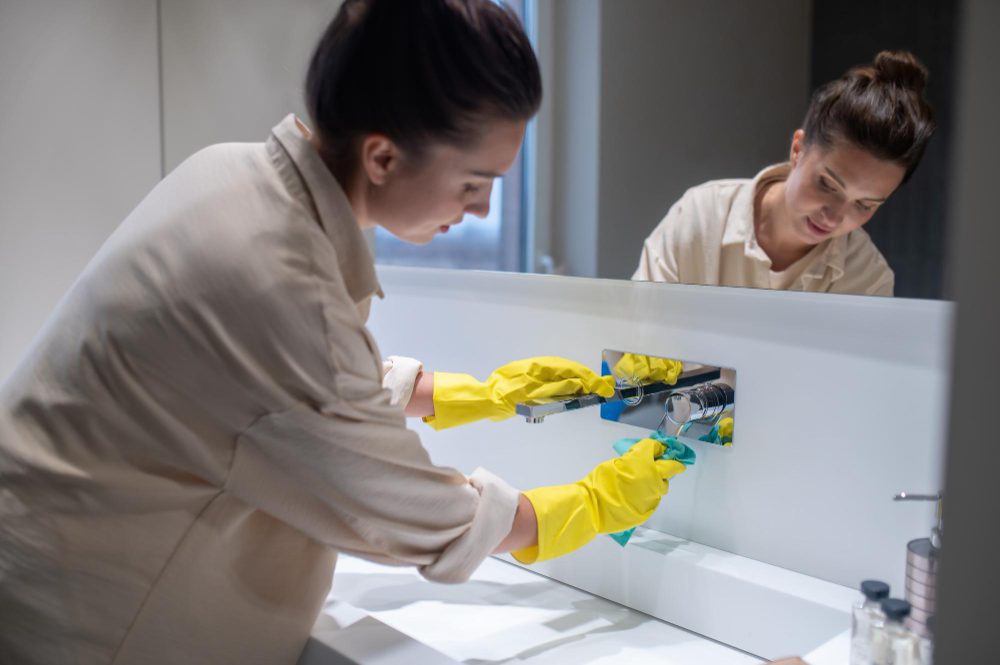
Chrome and stainless steel faucets develop white or brownish crusty deposits around the base, the aerator, and wherever water drips.
Soak method: Soak a cloth or paper towel in white vinegar and wrap it around the affected faucet. Secure with a rubber band and leave for one to two hours. Remove the cloth and scrub with an old toothbrush to work into the crevices and around the base. Rinse and dry.
For the faucet aerator (the small screen at the tip of the faucet): Unscrew the aerator and soak it in a cup of undiluted vinegar for thirty to sixty minutes. Scrub with a toothbrush, rinse, and reinstall. A clogged aerator also reduces water flow, so cleaning it has practical benefits beyond appearance.
For chrome fixtures with heavy buildup: Bar Keepers Friend applied with a damp cloth and a light scrub removes deposits without scratching chrome. Rinse thoroughly afterward.
Avoid: abrasive scrubbers or steel wool on chrome or nickel finishes. They scratch and permanently damage the surface.
How to Remove Hard Water Stains From Toilets
The ring at the waterline in a toilet bowl is one of the most common hard water problems. It’s a combination of mineral deposits and sometimes rust from iron in the water.
Turn off the water supply valve (located behind or beside the toilet) and flush to empty the bowl. This gives you direct access to the stains without fighting the water level.
Apply undiluted white vinegar to the stains and let it sit for thirty minutes to an hour. Scrub with a toilet brush. For stubborn rings, use a pumice stone (wet it first and use gentle pressure). A pumice stone is safe on porcelain when used wet and does not scratch if you’re not pressing hard.
For heavy mineral and rust staining: products like CLR or The Works (a hydrochloric acid-based toilet bowl cleaner) dissolve both mineral deposits and rust effectively. Apply, let sit briefly, and scrub. Never mix these products with bleach.
Repeat the process weekly or biweekly if hard water rings are a persistent issue.
How to Remove Hard Water Stains From Tile and Grout
Bathroom tile develops hard water deposits across the surface and around the grout lines. The approach differs depending on tile type.
Ceramic and porcelain tile: Spray with white vinegar or apply a paste of citric acid and water. Let sit for fifteen to twenty minutes. Scrub with a stiff grout brush for the grout lines and a sponge for the tile face. Rinse thoroughly.
Natural stone (marble, travertine, limestone): Do not use vinegar, citric acid, or any acid-based cleaner on natural stone. The acid etches and damages the surface. Use a pH-neutral stone cleaner specifically formulated for natural stone. This is one of the most common cleaning mistakes in bathrooms with marble tile.
For heavy grout staining: A baking soda paste applied to grout and then sprayed with vinegar creates a fizzing reaction that helps lift deposits from porous grout. Follow with vigorous scrubbing and rinse completely.
How to Remove Hard Water Stains From Stainless Steel
Sinks, appliances, and cookware develop water spots and mineral deposits.
For sinks: Spray with undiluted vinegar, let sit for ten to fifteen minutes, and scrub with the grain of the steel (always wipe with the brushed lines on stainless, never across them). Rinse and dry.
For appliances: A solution of equal parts water and vinegar applied with a microfiber cloth works well on stainless steel exteriors. Dry immediately to prevent new water spots.
Bar Keepers Friend is also excellent on stainless steel. Apply with a damp cloth using the grain direction, rinse completely, and dry.
Avoid: abrasive scrubbers, steel wool, and bleach on stainless steel. They cause scratching and corrosion.
Calcium Buildup Removal From Glasses and Dishware
Glasses and dishware that come out of the dishwasher with a cloudy film are experiencing hard water etching or deposits.
For removable deposits: Soak in a solution of one part white vinegar to two parts water for thirty to sixty minutes. The cloudiness from mineral deposits clears significantly. Rinse and hand dry.
For permanent etching: Unfortunately, hard water etching on glass is a chemical change that cannot be reversed by cleaning. It’s permanent fogging caused by prolonged mineral exposure. Prevention matters more here: use a rinse aid in your dishwasher, use a dishwasher salt if your machine has a softener compartment, and consider whether a whole-home water softener makes sense for your level of water hardness.
Preventing Hard Water Stains: Long-Term Strategies
Cleaning hard water stains is manageable. Reducing how often they develop is better.
Squeegee all wet surfaces after use. Glass, tile, and fixtures wiped or squeegeed dry after each shower dramatically slow the accumulation of deposits.
Dry faucets after use. A quick wipe with a dry cloth after using the sink prevents water from evaporating on the fixture.
Apply a water-repellent coating to shower glass. Products like Rain-X applied to clean shower glass cause water to bead and run off rather than sit and evaporate. Reapply every few months.
Consider a water softener. For households with very hard water, a whole-home water softener is the most effective long-term solution. It removes the dissolved minerals before they reach your fixtures and surfaces. The upfront cost is significant but the reduction in cleaning time and fixture wear is real.
Use a daily shower spray. Diluted vinegar or commercial daily shower sprays applied after each shower reduce mineral buildup between deep cleans.
When Professional Cleaning Handles the Heavy Work
Hard water stain removal, particularly from heavily soiled shower glass, grout lines, and toilet bowls, is one of the more time-consuming aspects of bathroom cleaning. It requires dwell time, physical scrubbing, and the right products for each surface.
Our deep cleaning service specifically addresses hard water deposits in bathrooms as part of a thorough whole-home clean. If your shower glass, tile, or fixtures have accumulated significant buildup, a professional deep clean is often the most efficient way to reset the surfaces, after which regular maintenance keeps them in better condition.
SHINENOS serves Eden Prairie, Minneapolis, Edina, Minnetonka, Plymouth, Maple Grove, Wayzata, and Excelsior.
Frequently Asked Questions
Does WD-40 remove hard water stains?
WD-40 can loosen some mineral deposits and works particularly well on chrome fixtures as a quick fix. It’s not a true cleaner for heavy buildup, but it’s useful for maintenance on chrome and can help prevent future deposits when wiped on and buffed off.
Why do hard water stains come back so fast?
Because the source hasn’t changed. As long as hard water is contacting your surfaces and evaporating, deposits will form. Prevention habits (squeegeeing, drying, repellent coatings) slow the return. A water softener reduces the problem at the source.
Can I use vinegar on all surfaces?
No. Never use vinegar or any acid-based cleaner on natural stone (marble, travertine, limestone, granite). It etches and permanently damages the surface. Use pH-neutral stone-specific cleaners on these materials.
How do I remove hard water stains from a shower head?
Fill a plastic bag with undiluted white vinegar, place it over the shower head so the head is submerged, and secure it with a rubber band. Leave for one to two hours (or overnight for heavy buildup). Remove the bag and run the shower to flush debris from the nozzles.
Are hard water stains the same as soap scum?
No. Hard water stains are mineral deposits (calcium and magnesium). Soap scum is a combination of soap residue and minerals that forms a gray or white film. Both respond to acid-based cleaners, but soap scum often needs a bit more scrubbing effort since it has an organic component.
What is the strongest hard water stain remover?
CLR and products containing hydrochloric acid (like The Works toilet bowl cleaner) are among the strongest commercially available options. Use them with appropriate caution, follow label directions, and ensure good ventilation.
Get Your Surfaces Back to Clean
Knowing how to remove hard water stains comes down to choosing the right hard water stain remover for each surface. Vinegar handles most situations, the right commercial product handles the rest, and prevention habits slow the return.
For bathrooms with heavy buildup that needs a professional reset, book a deep clean with SHINENOS and let our team tackle the hard work. Or visit our main site to explore all our cleaning services across the Twin Cities.