Granite countertops are a valuable addition to many Twin Cities kitchens, but improper cleaning products can cause lasting damage. While many homeowners believe they’re caring for their countertops correctly, the real problem is often using cleaners that aren’t safe for natural stone.
Most households have granite-damaging products sitting right next to their granite countertops: white vinegar, lemon juice, bleach, and all-purpose cleaners with citrus extracts. These are some of the most popular general cleaning products available, and all of them damage granite over time, either by etching the stone itself or by degrading the sealant that protects it.
This guide covers what granite actually is and why it requires specific care, the safe daily cleaning routine, how to disinfect without causing damage, how to remove stains correctly based on the stain type, and how to seal and maintain granite so it stays in good condition for decades.
Understanding Granite Before You Clean It
Granite is a natural igneous rock formed from cooled magma. Its composition varies significantly from slab to slab, which is part of what makes each granite countertop visually unique. The primary minerals are quartz, feldspar, and mica, with varying amounts of other minerals depending on where the stone was quarried.
Because granite is a natural porous stone, liquid can penetrate the surface and cause staining. To prevent this, granite countertops are sealed with a penetrating stone sealer at installation and should be resealed periodically. The sealant fills the pores and creates a barrier against moisture and oils.
Here’s the critical point: both the granite itself and the sealant can be permanently damaged by the wrong cleaning products. The damage from acidic cleaners is called etching, which appears as dull spots or cloudiness on the surface. Etching damages the stone itself, not just the sealant, and cannot be reversed without professional polishing.
This is why granite care is different from cleaning any other kitchen surface.
Products That Damage Granite (Never Use These)
This list is more important than the cleaning steps themselves, because many of these products feel intuitively safe or natural.
White vinegar: Vinegar is acidic (pH around 2-3). It’s excellent for mineral deposits on faucets and shower glass. On granite, it etches the stone and degrades the sealant. A single cleaning won’t cause visible damage. Repeated use over months creates a permanently dull, hazed surface.
Lemon juice and citrus-based cleaners: Same problem as vinegar. Citric acid etches granite. Products labeled as “natural” or “citrus-powered” are often particularly harmful to stone surfaces because they rely on citric acid as the active cleaning agent.
Bleach and bleach-based cleaners: Bleach doesn’t etch granite the way acids do, but it degrades the sealant, leaving the stone unprotected against staining. Repeated bleach use on granite countertops requires more frequent resealing and eventually causes the stone to become dull and porous-looking.
Ammonia-based cleaners: Window cleaners like Windex contain ammonia, which damages granite sealant. Many all-purpose sprays also contain ammonia.
Hydrogen peroxide (concentrated): Pharmacy-strength 3% hydrogen peroxide is safe for occasional stain treatment on granite. Concentrated hydrogen peroxide products are not.
Abrasive scrubbers and steel wool: Physically scratch the granite surface and sealant.
Generic all-purpose sprays: Most contain one or more of the above. Unless a product is specifically labeled as safe for natural stone, assume it’s not safe for granite.
Daily Granite Countertop Cleaning
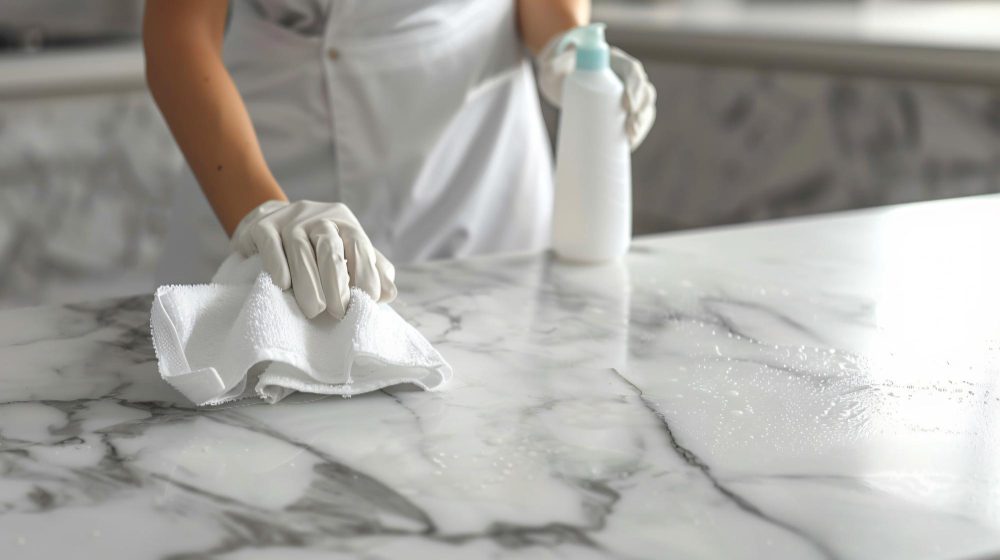
Daily cleaning of granite countertops requires nothing more than warm water, a small amount of mild dish soap, and a microfiber cloth.
Add a few drops of mild dish soap to warm water (do not use a dish soap with citrus extracts or degreasing agents that contain citric acid). Dampen a microfiber cloth in the solution, wring out most of the water, and wipe the countertop surface. Rinse your cloth with clean water frequently so you’re not spreading soapy residue.
The crucial final step: dry the countertop thoroughly with a clean, dry microfiber cloth. Water left sitting on granite can leave hard water mineral spots, particularly in Minnesota’s hard water areas. The mineral deposits don’t damage the stone but they create a hazy appearance that requires additional effort to remove.
That’s the complete daily cleaning routine. Frequency matters more than effort: daily wiping prevents the buildup that requires more aggressive cleaning.
DIY granite cleaner (safe version): For a more effective daily spray, mix half a cup of rubbing alcohol, one teaspoon of mild dish soap, and one and a half cups of warm water in a spray bottle. Add a few drops of essential oil if desired. This cleans, sanitizes lightly, and is safe for granite sealant. Spray, wipe, and dry.
How to Disinfect Granite Countertops Safely
Dish soap and water clean and sanitize granite adequately for everyday kitchen use. When you handle raw meat or poultry on or near granite surfaces, more thorough disinfection is warranted.
The safe disinfectant for granite is isopropyl rubbing alcohol (70%). Mix equal parts 70% isopropyl alcohol and water in a spray bottle. Spray the countertop surface, let it sit for three to five minutes (dwell time kills bacteria), then wipe with a clean cloth and dry.
70% isopropyl alcohol is effective against bacteria and many viruses without damaging granite sealant. Higher concentrations (90%+) evaporate too quickly to disinfect effectively. Lower concentrations are less effective.
Do not use disinfecting wipes on granite. Most disinfecting wipes contain citric acid or other ingredients that damage granite sealant despite the wipes feeling gentle.
How to Remove Stains From Granite Countertops
Stain removal from granite depends entirely on what caused the stain. Using the wrong removal method can make the stain worse or cause additional damage.
First, understand the distinction between a stain and etching. A stain is discoloration from a substance that has absorbed into the stone. It will appear as a dark or differently colored area. An etch is damage to the stone surface caused by acid. It appears as a dull spot that feels different from the surrounding stone. Stains and etching require different approaches.
Oil-Based Stains (Cooking Oil, Grease, Butter)
These appear as dark spots or spreading discoloration on granite. Oil has absorbed into the pores.
Make a paste of baking soda and water (for oil-based stains). Apply the paste to the stain and cover with plastic wrap. Tape the edges to create a seal. Leave for 24 to 48 hours. The paste draws the oil out of the stone as it dries. Wipe away the paste with a damp cloth. Repeat if the stain is not fully removed.
Water-Based Stains (Coffee, Tea, Wine, Juice)
Make a paste of baking soda and hydrogen peroxide (3% from the pharmacy). Apply, cover with plastic wrap, and leave for 24 hours. The hydrogen peroxide helps lift organic staining without damaging the stone at pharmacy concentration. Wipe clean and repeat if needed.
Hard Water Deposits (Minnesota-Specific)
Mineral deposits from hard water that build up on granite near the sink or faucet appear as white or grayish spots or haze. These are deposits on top of the stone, not stains that have absorbed in.
A small amount of granite-safe stone cleaner (such as StoneTech Professional or similar) handles mineral deposits on granite without the damage caused by vinegar. Do not use CLR, lime removers, or vinegar on granite for hard water deposits, despite these being the standard recommendation for hard water elsewhere in the home.
Etching (Dull Spots From Acid Contact)
Etching is damage to the stone surface, not a stain. Marble polishing powder (available at stone care retailers) applied with a soft cloth and rubbed in circles can improve light etching. Deep etching requires professional polishing.
Prevention is more practical than repair for etching. Clean up any acidic liquid (citrus juice, wine, coffee, vinegar, tomato sauce) immediately. Don’t let acidic foods or liquids sit on the granite surface.
How to Test if Your Granite Needs Resealing
Granite should be sealed at installation and resealed periodically. The resealing schedule depends on the stone’s porosity and the type of sealant used, typically every six months to three years.
The water test determines if resealing is needed: Leave a quarter cup of water on the granite surface for 15 minutes. If the water beads up and sits on the surface, the sealant is intact. If the water partially absorbs and leaves a dark spot, or if the spot remains damp after wiping, the sealant is depleted and the countertop needs resealing.
How to Seal Granite Countertops
Purchase a penetrating stone sealer specifically formulated for granite (brands include StoneTech BulletProof, Miracle Sealants 511, or similar). Do not use surface sealers or topical treatments.
Clean and dry the countertop completely. Apply the sealer with a clean cloth in a thin, even coat. Let it penetrate for the time specified on the product label. Wipe away any excess before it dries. Allow to cure according to the product instructions before using the counter normally.
Annual sealing with a quality product is a straightforward maintenance task that significantly extends the life and appearance of granite countertops.
Granite vs Other Stone Countertops: Cleaning Differences
Many Minnesota kitchens have stone countertops that are not granite, and the cleaning rules differ.
Quartz countertops: Engineered quartz (brands like Silestone, Caesarstone) is non-porous and doesn’t require sealing. It’s more resistant to staining and etching than natural granite. However, it can still be damaged by harsh chemicals and highly acidic cleaners. Mild soap and water or a pH-neutral cleaner is appropriate.
Marble and limestone: Much more sensitive to acid than granite. Etching happens very quickly from everyday kitchen acids (coffee, orange juice, tomato sauce). These stones require pH-neutral cleaners and immediate cleanup of any spills. Vinegar should never come near marble.
Soapstone: Non-porous, requires mineral oil treatment rather than sealing. More resistant to staining than granite.
Quartzite: Natural stone often confused with quartz. Requires the same care as granite: sealing, pH-neutral cleaners, no acidic products.
Professional Kitchen Cleaning and Granite Care
Professional cleaning services that work regularly in homes with granite countertops use only pH-neutral, stone-safe cleaning products. They know which products to avoid, which is why professionally cleaned granite often looks better maintained than granite cleaned with household products.
SHINENOS’s recurring cleaning service covers kitchen countertops using products appropriate for your surface type. Our deep cleaning service addresses the full kitchen including countertops, and we accommodate specific product preferences for households with natural stone.
We serve Minneapolis, Eden Prairie, Edina, Minnetonka, Plymouth, Maple Grove, Wayzata, and Excelsior.
Frequently Asked Questions
What is the best cleaner for granite countertops?
Mild dish soap with warm water is best for daily cleaning. For disinfecting, equal parts 70% isopropyl alcohol and water. For stains, baking soda pastes with water (oil stains) or hydrogen peroxide (water-based stains). For everything else, a pH-neutral stone cleaner specifically formulated for granite.
Can I use vinegar to clean granite countertops?
No. Vinegar is acidic and etches granite, causing permanent dull spots and degrading the sealant. This is one of the most common mistakes homeowners make with granite. Despite being widely recommended as a natural cleaner, vinegar should never be used on any natural stone surface.
How do I remove hard water stains from granite?
Use a granite-safe stone cleaner rather than acidic products like CLR or vinegar. A paste of baking soda and water applied to the stain and left for 30 minutes can help with mineral deposits on the surface. Hard water deposits on granite require different treatment than hard water deposits on chrome or glass.
How often should granite countertops be sealed?
Perform the water test annually: if water absorbs within 15 minutes rather than beading up, reseal. Most granite needs resealing every one to three years depending on the stone and the type of sealer used.
Is it safe to prepare food directly on granite countertops?
Yes. Sealed granite is food-safe. However, granite is harder than most knife blades and will dull them quickly. Use a cutting board rather than cutting directly on the stone.
What’s the difference between etching and staining on granite?
A stain is dark discoloration from a substance absorbed into the stone. An etch is a dull spot caused by acid damaging the stone surface. Stains are addressed with drawing pastes. Etching requires polishing powder or professional restoration. Prevention through immediate spill cleanup is more practical than either repair.
Can you use disinfecting wipes on granite?
No. Most disinfecting wipes contain citric acid or other ingredients that damage granite sealant despite their gentle feel. Use the alcohol and water solution described above for disinfecting.
Protect Your Granite Investment
Granite countertops cleaned and maintained properly look beautiful for decades. The key is knowing which products to avoid and building a simple daily routine with the right ones.
For professional kitchen cleaning that treats your granite countertops with the appropriate products every visit, book a recurring cleaning with SHINENOS or contact us for a quote.